

A "Fermi estimate" thought experiment about how many unsubsidized literary magazines the subscriber market can actually support. Hint, it's less than you think...
I happened to come across the wonderful website of Erika Krouse and noticed she had done the heavy lifting of find out, and putting into an excel sheet, the circulation of literary magazines. Honestly, I don’t know her methodology for finding out this information, but it got my mind thinking about the circulations of various literary magazines.
I should start by saying this thought experiment is more a Fermi estimate than a rigorous review. That said, the main thing that struck me is how many wonderful, and important, literary magazines have circulations much smaller than I expected. Many prestigious and truly outstanding literary magazines were listed as having a circulation in the 2,000 range. That’s not 200k, that’s 2,000. [Of course, you could also include website reads, but I’m skipping that for now.]
The largest, by far, was The New Yorker at one million, followed by The Atlantic at 494,000. It quickly drops off from there. Ploughshares, a iconic literary magazine found in 1971, ranks 21st on the list with a circulation of just 6,500.
In fact, of the 71/400+ literary magazines that listed their circulations, the median circulation was 3,000. While it’s certainly possible there was some literary magazine with a monster circulation not listed, a quick look at the list of names doesn’t have any that really jump out. In fact, I think the more probable situation is those that don’t report do so because reporting circulation would hurt, rather than help, their reputation as a publisher. But, maybe not, I really have no idea and don’t know the data-gathering methodology.
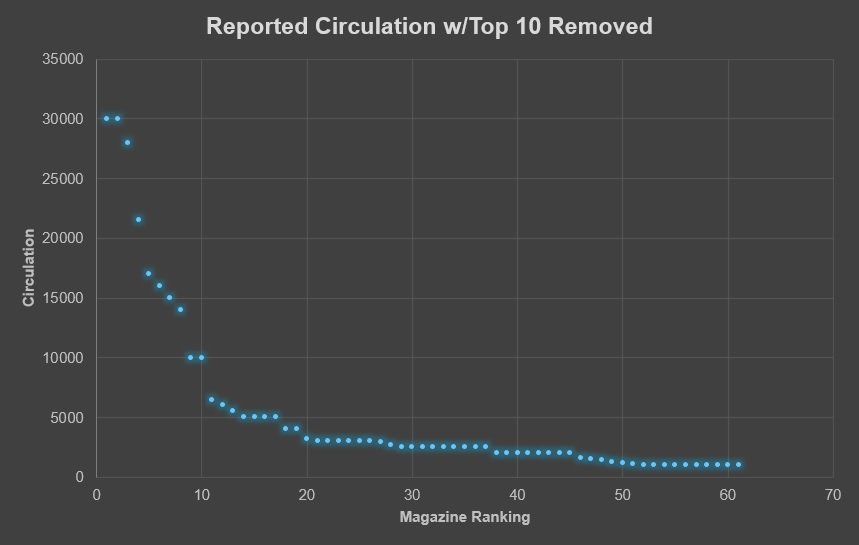
Even with the numerous flaws in this thought experiment, what conclusions do I think I can draw? First, that literary magazines are a winner-take-all or, more likely, a winner-take-most economy. Second, that most literary magazines (and certainly those under 5-10 years old) probably have a circulation of 500-1,000. Third, that well known literary magazines with a strong reputation probably has a circulation of about 2.500-4,000. And finally, that there are handful of publications that have 85%-90% of all paid literary magazine subscriptions and make all the money.
Which leads me to my final conclusion in my Fermi estimate thought experiment and that is, that the market only can support a dozen or so literary magazines that exists as a functioning long-term business model, unsupported by arts grants, an army of unpaid interns/volunteers, and/or a supporting educational institution.
What are your thoughts on my thought experiment? Do you agree, or are there issues or mistakes here I have failed to consider?
Kolby - Editor-In-Chief @ After Dinner Conversation
[I didn’t include budget information for a literary magazine as “functioning long-term business model” However, we could assume at least a few paid staff members making at least a poor living wage. I will leave you to do the math about what the means for an annual operating budget, and what number of subscriptions or combination of subscriptions and paid advertising revenue are needed to support that budget.]
[Excuse any typos/grammar issues, I tend to write quickly, publish, and later go back and correct later.]